
Hyperhidrosis Treatment in Philadelphia: Botox for Excessive Sweating
If you’ve ever ruined a shirt before lunch, avoided raising your hand in a meeting, or skipped shaking someone’s hand because yours were soaked, you probably already know what hyperhidrosis is. You just might not know it has a name, that it affects roughly 15 million Americans, or that there’s an FDA-approved treatment that works remarkably well.
We treat it here, so read this knowing that. What I can tell you in exchange is where the evidence is strong, where it isn’t, and where a different option might suit you better than the one we lead with.
What is hyperhidrosis, exactly?
Hyperhidrosis is sweating well beyond what the body needs for temperature control. It isn’t about being out of shape or anxious, though both can make it worse. Primary focal hyperhidrosis has a genetic component: the eccrine sweat glands in specific areas — underarms, palms, soles, forehead — are simply overactive. It typically begins in adolescence or early adulthood and persists indefinitely without treatment.
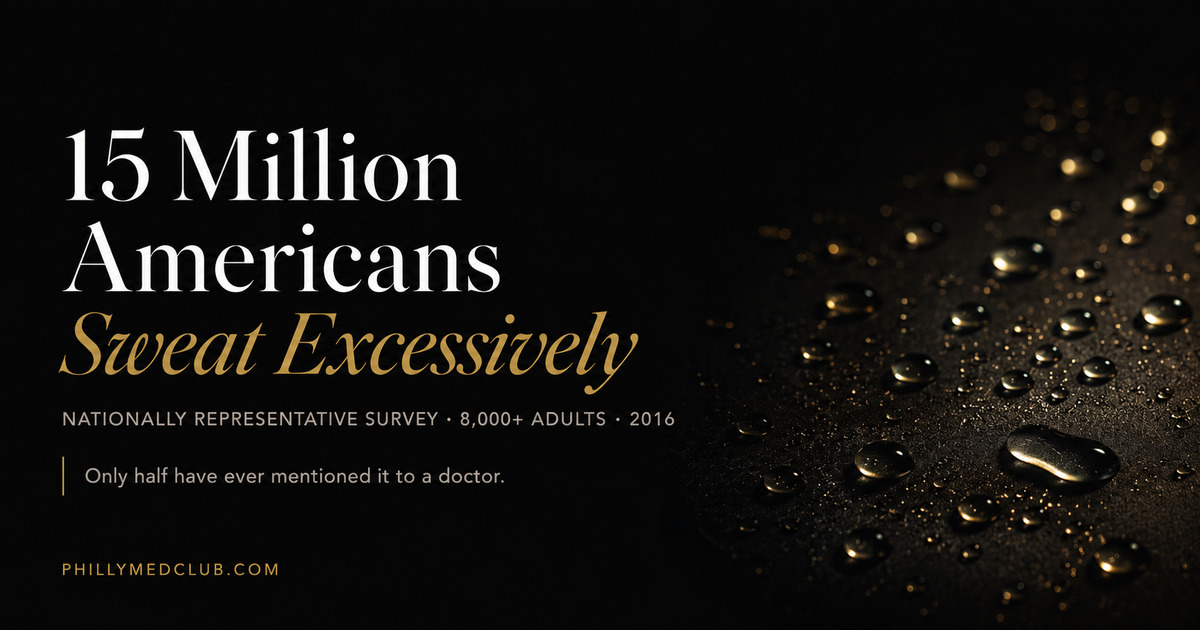
The numbers are striking. A nationally representative survey of more than 8,000 people put the prevalence at 4.8% of the U.S. population, roughly 15.3 million people, and 70% of those reported severe excessive sweating in at least one area. Here’s the part that gets me: only 51% had ever mentioned it to a healthcare provider. The reasons given were that they didn’t think it counted as a medical condition, or they assumed nothing could be done.
The effect on daily life is not trivial. People with severe hyperhidrosis report real limitations at work, in relationships and in physical activity, along with significant emotional distress — a burden researchers have compared with that of other chronic skin conditions.
How does Botox stop sweating?
It interrupts the signal, not the gland. OnabotulinumtoxinA blocks the release of acetylcholine at the nerve endings that supply the sweat glands, so the message telling them to produce sweat never arrives. The gland is left intact; it simply stops being told what to do. The FDA approved this use for severe primary axillary hyperhidrosis in 2004.
The clinical data is strong and it goes back decades. A multicentre trial in the New England Journal of Medicine treated 145 patients whose sweating had not responded to aluminium chloride for over a year, injecting botulinum toxin A into one underarm and placebo into the other in a randomised, double-blind design. Each patient served as their own control.
A separate double-blind, placebo-controlled study in Dermatologic Surgery followed eighteen patients monthly for five months after a single treatment. Sweat production in the treated group fell by an average of 91.6% at two weeks. That study is small, and I’d weight the multicentre trial more heavily — but the five-month follow-up is what makes it useful, because duration is the question patients actually ask.
What does the treatment actually involve?
The treatment takes approximately twenty minutes with a series of small pinches. We map the area first using a starch-iodine test: iodine and cornstarch go onto the skin, and wherever you sweat turns purple-black, that is where you sweat the most. That gives us a picture of where your glands are most active rather than a guess. Then we inject small amounts of Botox just under the skin across the mapped area, typically 50 units per underarm.
Most people need no anaesthesia for underarms. We can apply topical numbing if you’d prefer it, and for palms we use a nerve block, because hands are a different proposition entirely.
Results begin within a few days and reach full effect at about two weeks. Duration averages six to nine months, and some patients get twelve before they need retreating.
On dosing, the honest answer is that more is not clearly better. A 2024 study comparing 50 units against 100 units per underarm found no significant difference between the two in either severity scores or quality of life. It was observational rather than randomised, and small — thirty-one patients — so I wouldn’t treat it as the last word. But it’s the direct comparison that exists, and it doesn’t support paying for more units.
Which areas do you treat?
Underarms and palms. We do not treat feet.
Underarms are the most common and the most predictable. Palms respond well but are a larger undertaking — more units, considerably more discomfort during injection, and a possibility of temporary weakness in fine grip. That is usually mild and short-lived, but if you play an instrument or your work depends on hand strength, it is worth talking through first.
Only the underarm use is FDA-approved; palmar injection is done off-label, which is common practice and worth knowing rather than being surprised by.
Is there an option that lasts longer than injections?
Yes, and it works by a different mechanism, which is why the choice genuinely matters.
Botulinum toxin interrupts the nerve signal and leaves the gland intact, so it needs repeating roughly twice a year. Radiofrequency microneedling — Morpheus8 at a setting chosen for this purpose — delivers heat at the depth where sweat glands sit and damages the glands themselves. Sweat glands do not regenerate, so the reduction can be lasting. Most patients need two to three sessions.
The trade-off is straightforward. Toxin is quicker, more predictable and recurring. Radiofrequency asks for a course of treatments and some downtime, and aims at a result you are not buying again every six months. We lay out both rather than steering you toward the one that brings you back.
Fact vs. Fad: miraDry (microwave thermolysis) is marketed as a permanent solution, and it is a legitimate FDA-cleared device that destroys sweat glands with microwave energy. We do not offer it. Two things temper the “one and done” framing wherever you have it done: many patients need a second session, and results vary. More importantly, destroying a gland is not reversible, whereas blocking a signal is — if you dislike the result of Botox, it wears off. That is a real difference in the risk you are accepting, and it is an argument for trying the reversible option first.
Does insurance cover Botox for sweating?
Often, yes, and most people don’t know it. Because this use is FDA-approved rather than cosmetic, many plans will cover it once you’ve documented that at least one prescription-strength antiperspirant — typically aluminium chloride — failed to control it. We help patients through the prior authorisation process.
If you’re paying out of pocket, the cost reflects the units used, typically 100 units for both underarms.
When should you see a physician about sweating?
When it’s interfering with your daily life and clinical-strength antiperspirants haven’t given you adequate relief. That’s the threshold, and most people wait far longer than that.
The reason to start with a physician rather than book a treatment is secondary hyperhidrosis — excessive sweating caused by something else, such as thyroid disease, diabetes or a medication side effect. That needs ruling out first, because treating the sweating would mean missing the cause.
There is also a good chance injection is not your first step. Prescription-strength topicals resolve the problem for a meaningful number of people, and oral medication helps when the sweating is not confined to one area. Being physicians means we can write for those rather than only offering the injectable treatment we happen to sell — and if a topical solves your problem for a fraction of the cost, that is the better answer.
One of our physicians evaluates every hyperhidrosis patient personally: full history, secondary causes excluded, and an honest discussion of all the options including topicals, neurotoxin injections and energy-based treatment, before anyone recommends a plan. You can read more on our hyperhidrosis treatment page. Consultations are complimentary.
References
Doolittle J, Walker P, Mills T, Thurston J. Hyperhidrosis: an update on prevalence and severity in the United States. Archives of Dermatological Research. 2016;308(10):743–749. doi:10.1007/s00403-016-1697-9
Heckmann M, Ceballos-Baumann AO, Plewig G. Botulinum toxin A for axillary hyperhidrosis (excessive sweating). New England Journal of Medicine. 2001;344(7):488–493. doi:10.1056/NEJM200102153440704
Odderson IR. Long-term quantitative benefits of botulinum toxin type A in the treatment of axillary hyperhidrosis. Dermatologic Surgery. 2002;28(6):480–483. doi:10.1046/j.1524-4725.2002.01252.x
Antón Andrés MJ, Candau Pérez ED, Bermejo de la Fuente MP. Treatment of primary axillary hyperhidrosis with two doses of botulinum toxin A — observational study. Toxins. 2024;16(7):320. doi:10.3390/toxins16070320 (observational, non-randomised, n=31)
U.S. Food and Drug Administration. Approval of onabotulinumtoxinA for severe primary axillary hyperhidrosis; 2004. (labeling)
.png)