How Much Does Botox Cost in Philadelphia in 2026?
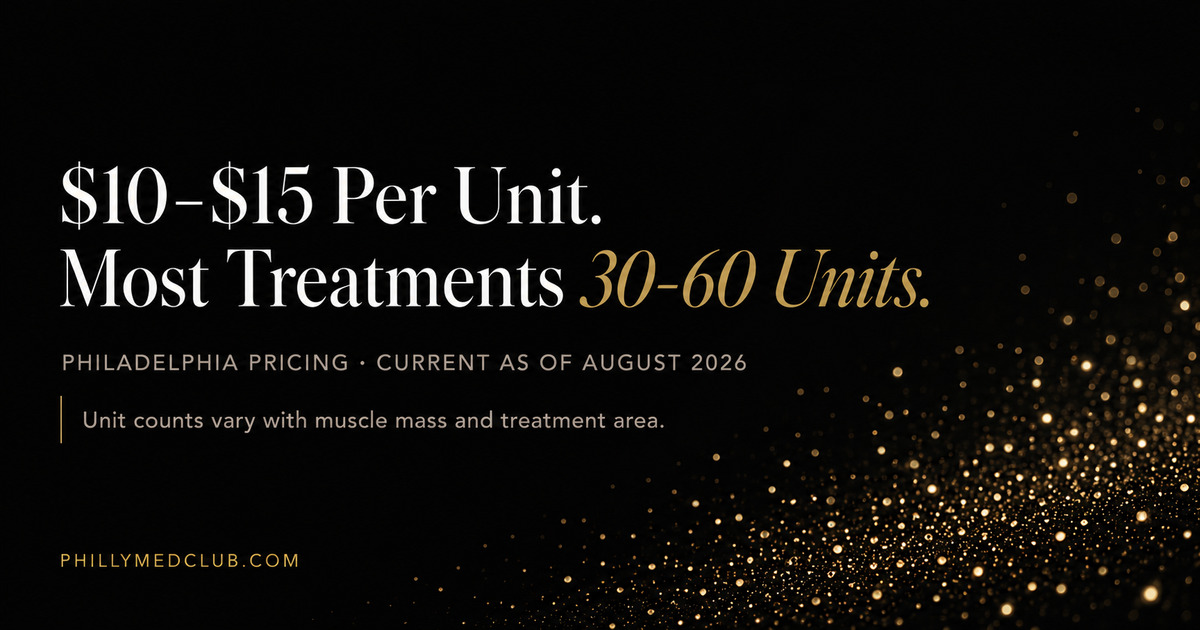
At PhillyMedClub, Botox and other neurotoxins currently cost between $11 and $14 per unit. Our minimum treatment is 30 units, and most patients land between 30 and 60 units per visit — putting a typical treatment between $330 and $840. The exact number depends on which areas you’re treating, which product you choose, and your individual anatomy.
Pricing updated October 1, 2026.
That’s the simple version. The more useful question isn’t “how much does it cost?” It’s “what am I actually paying for, and how do I know the number is fair?”
What determines how many units you need?
The number of units isn’t arbitrary. It reflects muscle mass, treatment area, and how deep your lines are at rest. In practice, the three upper-face areas each run about 20 units: roughly 20 for the forehead, 20 for the frown lines between the brows, and 20 across both sides for crow’s feet. Treat all three and you are at 60 units. That is the arithmetic behind our typical range.
Those numbers assume a natural result rather than a frozen one, which is what most of our patients ask for and what we aim to deliver. Dosing below what the muscle actually needs does not produce a subtler result — it produces a result that wears off early.
Two things move the number up. Men usually need full dosing or more, because the frontalis and corrugator muscles tend to be larger and stronger. And face size matters independently of sex: a patient with a broader face needs more product to cover the same muscles than a petite patient does. Neither is a judgement about anyone’s face — it is just how much muscle there is to treat.
This is one reason per-unit pricing is more transparent than a flat rate or a per-area price. When you know the per-unit cost and the unit count, you can check the arithmetic yourself.
Does the product matter — Botox, Dysport or Letybo?
Six botulinum toxin type A products are currently FDA-approved and available in the U.S. for cosmetic use: onabotulinumtoxinA (Botox Cosmetic), abobotulinumtoxinA (Dysport), incobotulinumtoxinA (Xeomin), daxibotulinumtoxinA (Daxxify), prabotulinumtoxinA (Jeuveau), and letibotulinumtoxinA (Letybo), approved in February 2024. A seventh botulinum product, rimabotulinumtoxinB (Myobloc), is FDA-approved but is a type B toxin used for medical indications such as cervical dystonia rather than for cosmetic treatment.
The critical point that often gets lost in marketing: units are not interchangeable between products. Each neurotoxin has its own potency assay and manufacturing process. The FDA prescribing information states this explicitly, and peer-reviewed data confirms it. A 2024 retrospective study published in Toxicon found no standard dose-conversion ratio between onabotulinumtoxinA and abobotulinumtoxinA — the ratios varied depending on the specific muscle being treated.
Fact vs. Fad: You may see practices advertising “Dysport is cheaper than Botox.” Unit for unit the sticker price often is lower, but you typically need roughly 2.5 to 3 times more Dysport units to achieve a comparable effect in the same area. Once you calculate the total treatment cost, the difference is usually modest. A practice telling you Dysport is dramatically cheaper is either underdosing or not comparing like with like.
What is Letybo, and why do you use it?
Letybo (letibotulinumtoxinA) is the sixth type A neurotoxin to earn FDA approval in the U.S., and it has been a leading neurotoxin brand in South Korea for several years. Approval was based on three Phase III trials — BLESS I, BLESS II and BLESS III — enrolling more than 1,000 subjects.
We offer Letybo through our ToxClub membership, a loyalty model that reduces the per-unit cost for patients who plan to maintain treatment across the year.
What should a treatment cost, area by area?
These are approximate ranges at current pricing. Your provider will recommend exact dosing at consultation.
- Forehead lines: around 20 units, roughly $220–$280
- Frown lines between the brows: around 20 units, roughly $220–$280
- Crow’s feet, both sides together: around 20 units, roughly $220–$280
- Bunny lines (nose): 4–8 units, roughly $44–$112
- Lip flip: 6–10 units, roughly $66–$140
- Masseter or jawline slimming: 20–30 units per side — roughly $440–$840 for both sides treated together
A full upper-face treatment — forehead, frown lines and crow’s feet — comes to around 60 units, or roughly $660–$840 depending on product and dose.
What are the red flags on price?
Fact vs. Fad: If a deal sounds too good to be true, it often involves diluted product, undertrained injectors or, in the worst cases, counterfeit toxin. The FDA has issued multiple warnings about unauthorised botulinum toxin products entering the U.S. market. A legitimate practice buys directly from the manufacturer and can show you the sealed vial before reconstitution. Ask to see it.
At PhillyMedClub you choose your provider when you book, and the provider you choose is the one who injects you. Injectables are overwhelmingly performed by our physicians, and our physicians apply and monitor their own numbing. That matters because managing a complication such as ptosis or asymmetry requires anatomical training, not a weekend certification.
How can you save without cutting corners?
Allē Rewards gives points on every Botox and Juvéderm treatment that translate into dollars off future visits, and ASPIRE does the same for Dysport and Restylane. We report your treatments to both, so the points actually post — which is not universal, and worth asking about wherever you go. Cherry offers payment plans with no hard credit check for larger treatment plans. And ToxClub, our Letybo membership, reduces per-unit pricing for regular patients.
So what should you expect to pay?
Botox in Philadelphia in 2026 costs $11 to $14 per unit at our practice, with most treatments falling between $330 and $840. The biggest variable isn’t the product — it’s who is injecting you, and whether they are dosing appropriately for your anatomy. Consultations are complimentary, and we will give you a specific unit count and a price before any needle touches your face.
References
Bohart Z, et al. Real-world differences in dosing and clinical utilization of onabotulinumtoxinA and abobotulinumtoxinA in the treatment of upper limb spasticity. Toxicon. 2024;241:107678. doi:10.1016/j.toxicon.2024.107678 (retrospective study)
U.S. Food and Drug Administration. Drug Trials Snapshots: LETYBO (letibotulinumtoxinA); approved 29 February 2024.
.png)