
Philadelphia, PA
Spider Vein Treatment
What are spider veins?
Spider veins — telangiectasias — are small dilated vessels sitting just under the surface of the skin, usually red, blue or purple and often in a branching pattern. They are extremely common, particularly on the legs, and become more so with age, pregnancy, prolonged standing and family history.
They are usually a cosmetic concern. Sometimes they are the visible surface of something else, which is the part of this that most clinics skip.
How does the laser treat them?
We treat spider veins with a long-pulsed 1064 nm Nd:YAG laser, delivered through a dedicated vascular handpiece on our Candela GentleMax Pro. It is the same platform we use for laser hair removal and Nd:YAG skin revitalization, configured differently for vessels.
The 1064 nm wavelength is absorbed by hemoglobin inside the vein rather than by pigment in the skin above it. That heats the blood and the vessel wall, sealing the vein so it collapses and is gradually reabsorbed over the following weeks. The same property that lets this wavelength reach past the epidermis is why it is the safer choice on deeper skin tones.
Nothing is injected. No needle, and no sclerosing solution.
Which areas do you treat?
Face, legs, chest and hands.
Facial vessels — around the nose, across the cheeks, along the jaw — are the most commonly treated and generally the most responsive, because they are fine and sit close to the surface. Leg telangiectasias respond well up to roughly 3 mm in diameter. Broken capillaries on the chest and the backs of the hands, usually the legacy of years of sun, are treated the same way.
Do you treat cherry angiomas?
Yes, small ones, with the same laser.
Cherry angiomas are benign clusters of dilated capillaries — the small bright red domes that start appearing on the trunk and arms in your thirties and multiply with age. They are harmless. People have them treated because they do not like the look of them, which is a perfectly good reason.
The mechanism is the same as for a spider vein: the 1064 nm wavelength is absorbed by the hemoglobin in the vessels making up the lesion, which darkens and crusts before flaking away over a week or two. Most clear in a single session.
One caveat worth stating plainly. A lesion that is changing, that bleeds without being knocked, or that does not look like a straightforward cherry angioma gets examined before it gets treated, not after. Lasering something that should have been biopsied is a mistake we are not willing to make.
Is it safe on all skin types?
Yes. The 1064 nm wavelength penetrates past the epidermis with relatively little absorption by surface melanin, which is what makes it appropriate across Fitzpatrick I through VI — the same reason it is the standard wavelength for laser hair removal on deeper skin tones.
Safe is not the same as predictable, though. How well an individual vessel responds varies more than most patients expect, and it is not something anyone can tell you by looking at you. We generally recommend starting with a consultation and a small test area, then reviewing how those vessels react before you commit to a course. It costs you one short visit, and it is the honest way to find out.
Why laser rather than sclerotherapy?
Sclerotherapy — injecting a solution that irritates a vein into collapsing — is the long-standing standard for leg telangiectasias, and we do not offer it. You should know how the two actually compare rather than take our word that ours is better.
A systematic review of 26 studies covering 1,991 patients concluded that the long-pulsed 1064 nm Nd:YAG laser is a safe and effective option for leg veins up to 3 mm, with clearance rates similar to sclerotherapy and no significant difference between them. The same review found sclerotherapy tended to be less painful and to produce faster improvement, and that laser performed better on the finest vessels under 1 mm while sclerotherapy performed better between 1 and 2 mm.
A randomized comparative trial put the trade-off plainly: the 1064 nm laser is particularly suited to patients with needle phobia, patients allergic to sclerosing agents, and fine telangiectatic matting, while sclerotherapy has the advantage of reaching the feeder veins supplying a cluster.
On that last point, our experience is better than the literature might lead you to expect — most feeder veins do respond to the laser here. Where they do not is when a vessel sits deep, or is larger than roughly 3 mm. At that point Dr. Ghavami refers you to a vein specialist or vascular surgeon rather than persisting with a tool that is at the edge of what it can do.
So, honestly: for facial vessels, laser is the right tool and injection generally is not. For fine leg vessels the evidence puts the two level. What we will not do is chase a vessel that is deep or oversized — that is a referral, not a longer course of treatment.
When spider veins are a sign of something else
This matters and it is worth reading before you book a cosmetic treatment.
Spider veins on the legs are sometimes the surface expression of venous insufficiency — valves deeper in the leg failing to keep blood moving upward, raising pressure in the smaller vessels near the skin. If that is what is happening, treating the visible veins without addressing the underlying problem produces disappointing results and rapid recurrence, because the pressure that created them is still there.
Signs worth mentioning to us: aching or heaviness in the legs, swelling around the ankles by the end of the day, larger bulging varicose veins, skin discoloration or thickening near the ankle, or a previous blood clot. Any of those and the right next step is a venous ultrasound and a vein specialist — not a cosmetic laser session. We assess case by case and will point you in that direction rather than take the booking.
Who performs it?
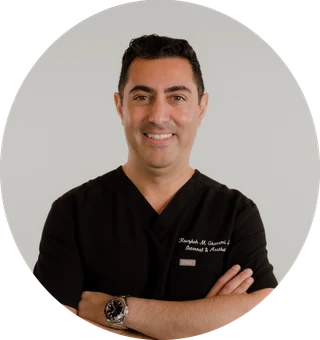
Dr. Ghavami evaluates every spider vein patient before treatment. Deciding whether your veins are cosmetic or the surface of something deeper is a physician's judgment, and it happens before anything is treated.
Dr. Ghavami performs the treatment himself. Carla Davila, our licensed medical aesthetician, is certified on the device and also treats, under his supervision. The two are priced differently, so you can choose on price as well as preference — and whoever you select at booking is who treats you.
Does it hurt, and what should I expect?
Thirty to forty-five minutes depending on the area. Most patients describe each pulse as a quick snap against the skin, similar to laser hair removal. The GentleMax Pro fires a burst of cryogen onto the skin milliseconds before each pulse, cooling the surface as the energy goes in, which makes treatment manageable for nearly everyone without numbing.
The published comparisons are consistent that laser is more uncomfortable than injection, and we would rather you hear that from us than discover it in the chair.
Immediately afterward the treated vessels darken and the area may look slightly raised and pink for a few hours. Bruising along the treated line is possible and settles within one to two weeks. Transient darkening of the skin along the vessel can occur and usually fades over a few months; it is reported somewhat more often after laser than after sclerotherapy.
Avoid hot baths, saunas and strenuous exercise for a couple of days, and use sunscreen on treated areas daily — sun exposure on freshly treated skin is what turns temporary darkening into a lasting mark.
Do I need compression socks afterward?
Yes. Wear graduated compression socks for at least two weeks after leg treatment. They support the vessel walls while the treated veins are clearing, and they reduce the venous pressure that works against your result.
If you are someone who forms spider veins easily, or your work keeps you on your feet for most of the day, we recommend wearing them routinely rather than only after a treatment. That is the single most useful thing you can do to slow new vessels appearing, and it costs a great deal less than another course of laser. We would rather tell you that than sell you the sessions.
Who should not have it?
Not over a fresh tan or self-tanner. Give it two weeks: extra melanin in the epidermis competes for the laser's energy and raises the risk of a burn or a pigment change. Active infection or broken skin over the area means rescheduling.
Pregnancy, a previous blood clot or a known clotting disorder, blood thinners, and photosensitizing medication all need discussing before anything is scheduled. None of those is automatically a no; they change how, or whether, we proceed.
How many sessions, and are the results permanent?
Most patients need two to four sessions, spaced to let each one finish working before we judge what is left. Vessels fade over four to six weeks rather than disappearing on the day, which is why we do not stack treatments closer together.
The vessels we treat are gone for good — a sealed vein does not reopen. New ones can form over time, because the tendency that produced the first set does not disappear. Occasional maintenance is normal rather than a sign that something failed, and compression is what stretches the interval between visits.
Further reading
When laser isn't the right tool for your veins
Not every vessel responds to the 1064 nm Nd:YAG, and no one can promise you which will from an examination alone. So we treat a small test area first and look at the result. If those vessels clear, we continue. If they don't, we tell you, rather than selling a package on the hope that the next session goes better. Vessels that don't respond are usually fed by something deeper, which is a vascular question rather than a cosmetic one — we refer to the vascular service at Penn or Cooper. The test area costs one short visit, and it is the only honest way to answer the question.
Why choose PhillyMedClub for spider vein treatment in Philadelphia?
We treat with a long-pulsed 1064 nm Nd:YAG through a dedicated vascular handpiece on our Candela GentleMax Pro. Nothing is injected — the wavelength is absorbed by hemoglobin inside the vessel rather than by pigment in the skin above it, which is also why it is safe on all skin types. We do not offer sclerotherapy, and rather than claim ours is better we set out how the two actually compare so you can decide. We also look at why the veins are there, because sometimes they are a sign of something else. You choose your provider at booking — Dr. Ghavami or Carla — and the two are priced differently. Treated veins are very likely gone for good; new ones can form, because the tendency that produced the first set does not disappear. From $199 a session in Fishtown, Philadelphia.
Requested by male patients for leg and facial vessels, and for broken capillaries across the chest. We assess for underlying venous insufficiency before treating rather than after.
Leg spider veins are among the most requested treatments among our female patients, and we treat them with laser rather than injections. We check first whether the veins are the surface of an underlying venous problem, because treating them cosmetically over untreated reflux means they come straight back.
Frequently asked questions
How does the laser treat spider veins?
The 1064 nm Nd:YAG wavelength on our Candela GentleMax Pro is absorbed by hemoglobin inside the vessel. That heats the blood and the vessel wall, sealing the vein so it collapses and is gradually reabsorbed over the following weeks. Nothing is injected. The surrounding skin is left intact because the energy is absorbed by the vessel rather than by the skin above it.
How many sessions are needed?
Most patients need two to four sessions depending on how many vessels there are and how large they are. Because response varies more between individuals than most people expect, we generally start with a consultation and a small test area to see how your vessels react before you commit to a course. Vessels fade over four to six weeks rather than immediately, so sessions are spaced to let the previous one finish working before we judge what is left.
Are results permanent?
The veins we treat are gone for good — a collapsed vein does not reopen. New ones can form over time, because the tendency that produced the first set does not disappear. Most patients come back occasionally for touch-ups rather than repeating the whole course. If you are asking about cherry angiomas rather than veins, mention it when you book or give us a call — it is usually a short addition to a visit rather than an appointment of its own.
Related services


.png)