
Philadelphia, PA
Hair Restoration
What is PRP for hair loss?
Platelet-rich plasma is a concentrate made from your own blood. We draw it, spin it down to separate the platelet-rich fraction, and inject it into the scalp. Platelets carry growth factors involved in tissue repair and signaling, and the rationale is that delivering them around miniaturized follicles helps push those follicles back toward producing thicker, terminal hair. The preparation kits we use come with biotin included.
It requires no surgery and no downtime, which is the main reason patients consider it before a transplant.
Does PRP for hair loss actually work?
Yes, with qualifications worth understanding before you spend money on it.
Multiple randomized trials and the meta-analyses pooling them find that PRP increases hair density compared with placebo. One meta-analysis of nine randomized trials found statistically significant density gains at both three and six months. A larger review of fourteen studies covering 431 patients reached the same direction of effect — but noted high heterogeneity between studies and evidence of publication bias, and called for better-quality trials. A separate review in women found benefit as well, with the same caveat that protocols need standardizing.
Read together: the effect is real and reasonably consistent in direction, the size of it varies a great deal, and “PRP” is not one standardized thing. Preparation method, spin protocol and platelet concentration differ between clinics, which is part of why trial results differ so widely.
Where PRP fits alongside medication — and what we can prescribe
This is the part most clinic pages leave out. Minoxidil and finasteride have the strongest evidence base of any treatment for androgenetic alopecia — stronger than PRP, and considerably cheaper.
That does not make PRP pointless. It makes it an addition rather than a replacement. The patients who do best combine approaches, and the ones who do worst are those who paid for injections while declining the cheap, well-evidenced medication because nobody framed the choice honestly.
Because we are physicians, we can do something about that in the same visit. Finasteride is FDA-approved for male pattern hair loss. Low-dose oral minoxidil and dutasteride are prescribed off-label for hair loss — widely and with reasonable support, but off-label, and we would rather say so than let you assume otherwise. Which of these suits you depends on your sex, your medical history and whether pregnancy is a consideration, since the anti-androgens are not appropriate for women who are or may become pregnant.
That is the practical difference between a physician practice and a medspa here. A medspa can offer you an injection and nothing else — so an injection is what you get offered.
Why we look for a cause first
Androgenetic alopecia is the most common cause of hair loss, but it is not the only one. Iron deficiency, thyroid disease, hormonal changes, recent illness, rapid weight loss and certain medications all cause hair loss, and several of them are correctable.
This matters most for women, whose pattern loss is more often multifactorial. Because we are a physician practice, treatment starts with an in-office consultation: a history, an examination and blood work where indicated — not just a quote for a package. If your ferritin is low or your thyroid is off, treating that may do more for your hair than anything we inject, and we would rather find out first.
PRP after a hair transplant
A good share of the patients we treat here had their transplant somewhere else — often another city, frequently another country — and come to us for the PRP that follows it. We are glad to take that on, and you do not need to have been our patient before.
Transplant surgeons commonly recommend PRP around the procedure to support the grafts and the native hair among them, and patients who traveled for surgery usually have no practical way of returning for it. Bring whatever documentation you have — the surgeon's protocol, the date, what was done and where — and we will work to it. If you have none, we will assess and advise from there.
One thing worth understanding: the transplanted follicles are taken from areas that resist the hormonal process driving the loss, so they will grow. The hair around them is still subject to it. Patients who have a transplant and then do nothing else often find themselves thinning around an otherwise good result a few years later, which is the actual argument for ongoing treatment.
Who is a good candidate?
Men at Norwood I–IV and women at Ludwig I–II — early to moderate loss where the follicles have miniaturized but are still alive. PRP works on struggling follicles. It cannot bring back follicles that are gone, so a smooth, shiny bald scalp will not respond, and any clinic suggesting otherwise is selling you something.
How the injections are done
We use a mesotherapy injector — the U225 — or by injecting the scalp freehand, delivering a rapid series of small injections at a set depth, evenly distributing the PRP across the treatment area.
Laser-assisted delivery, and where PDGF+ fits
We also offer a scalp protocol using the LaseMD Ultra at a setting that creates microscopic channels in the scalp. Immediately afterward we apply PDGF+, a topical growth-factor preparation, while those channels are briefly open — the same principle we use on the face.
Two things worth being clear about. PDGF+ is applied topically, not injected — we do not inject products that are not cleared for injection, whatever the marketing around them suggests. And some practices run this protocol with KeraFactor, a topical partnered with the laser manufacturer; we use PDGF+ instead. It is a preference rather than a claim of superiority.
Whether this is worth adding to your plan depends on what we find at consultation, and it is one of the things we will talk through then rather than assuming.
How many sessions, and then what?
An initial series of three to four sessions spaced four to six weeks apart, then maintenance every six to twelve months.
The maintenance is not an upsell, it is the nature of the condition: androgenetic alopecia is progressive, and stopping treatment means the process resumes. Anyone considering this should plan for an ongoing commitment rather than a one-off course, and if that does not appeal, it is better to know now.
What should I expect on the day?
Sixty to seventy-five minutes including the blood draw and preparation. We do not use topical anesthetic, as studies have shown this to neutrilze the PRP, renduring it ineffective; most patients describe the injections as brief stinging rather than pain. Scalp tenderness for a day is common. There is no downtime and you can wash your hair the following day.
What do the results look like?
Before and after photographs of hair restoration patients treated at our Fishtown practice are in our results gallery. Individual results vary.
Further reading
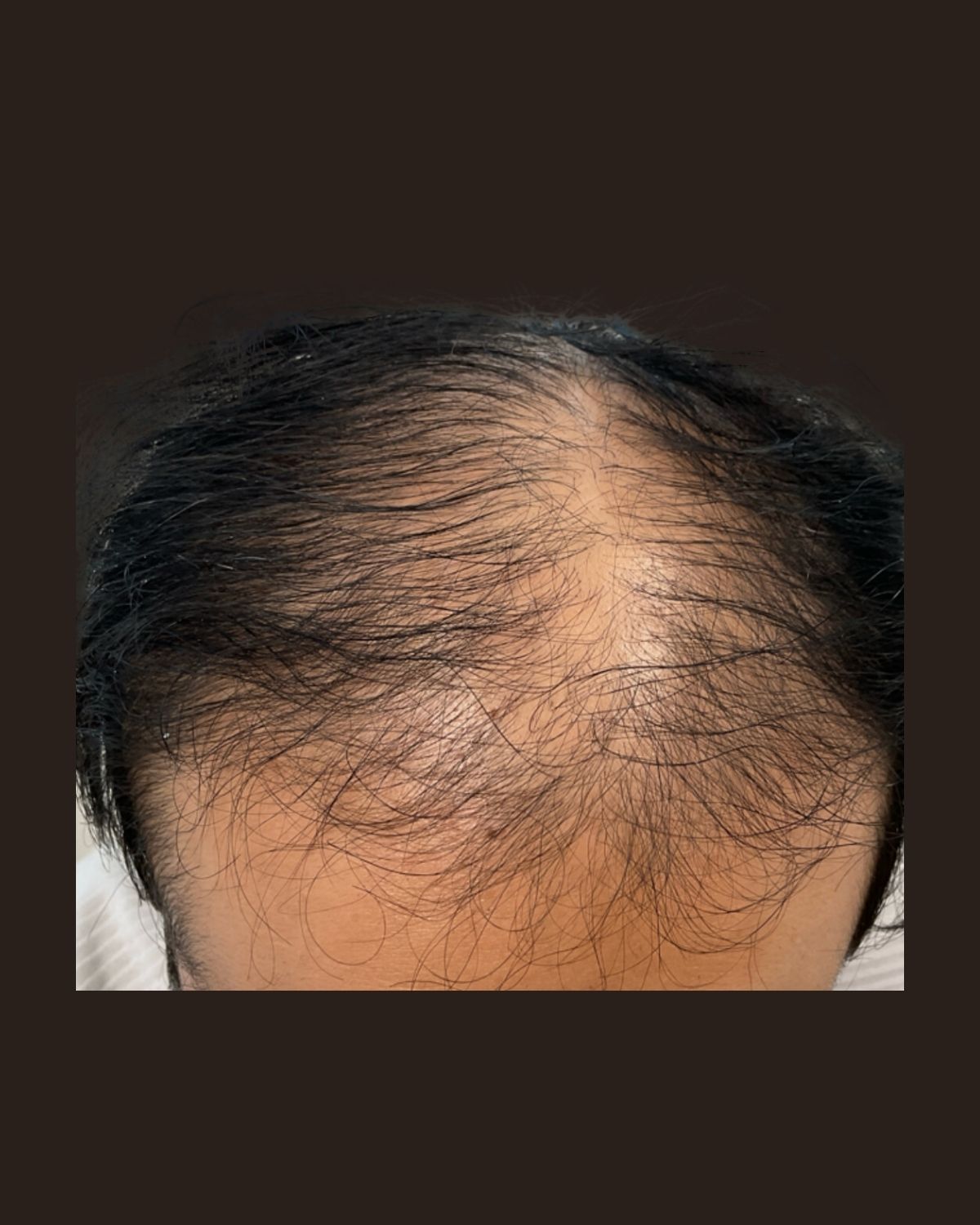
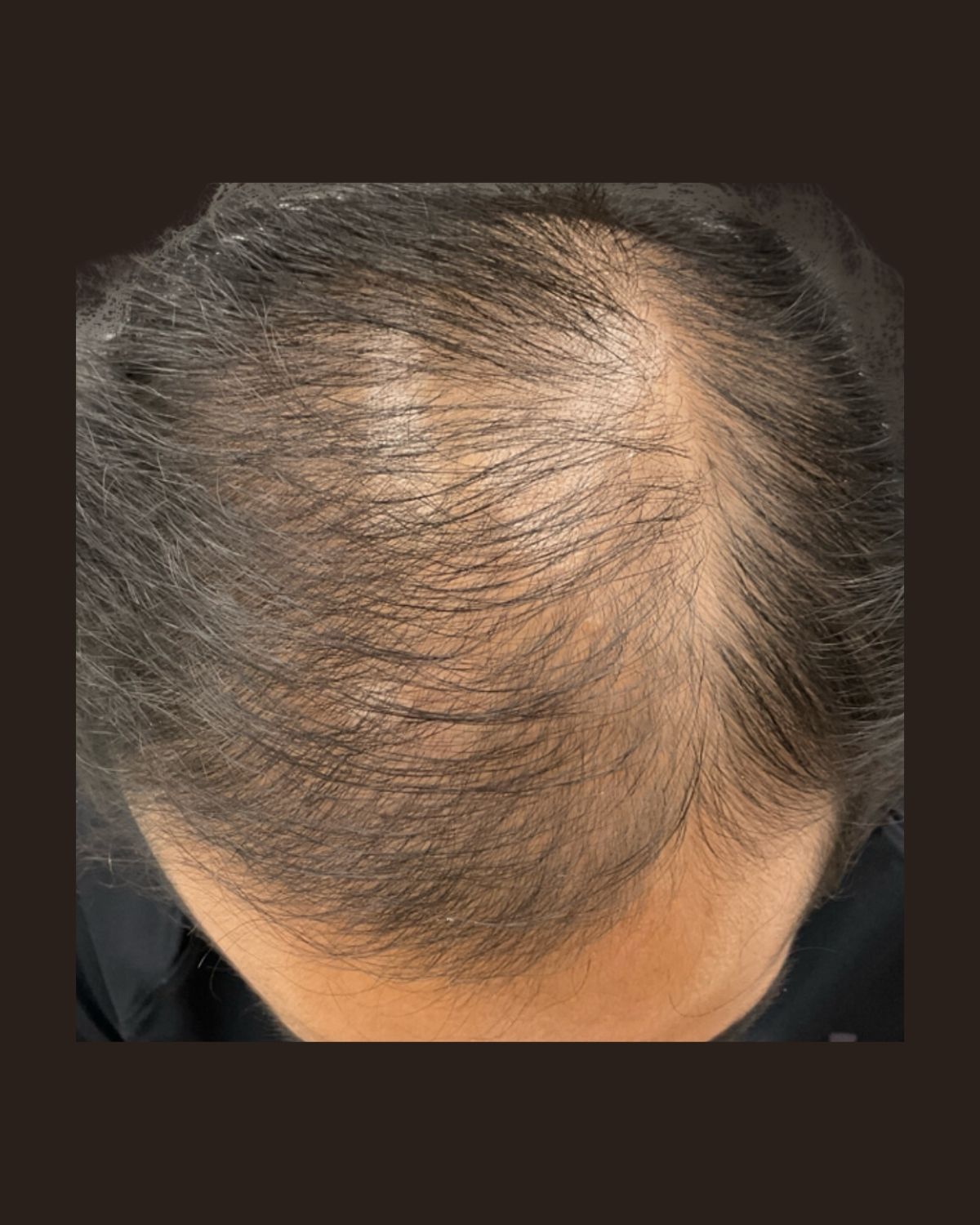
Before → After
3 hair PRP treatments, 4 weeks apart. Photographed 3 months later.
When hair loss needs a transplant, not an injection
PRP and medication work on follicles that are still alive. Where loss is advanced, where the scalp is smooth with no visible miniaturized hair, or where scarring alopecia has destroyed the follicle, nothing we inject will bring hair back — and continuing to treat mainly costs you time and money. Those patients are better served by a hair transplant surgeon, and we will tell you when you have reached that point rather than selling another round.
Why choose PhillyMedClub for hair restoration in Philadelphia?
Hair loss at PhillyMedClub starts with a medical workup rather than an injection. Before we discuss PRP we look for causes that are actually treatable — iron, thyroid, hormonal and medication-related — because addressing those is often what changes the trajectory. Because we are licensed physicians we can prescribe as well as inject, including low-dose oral minoxidil, which is off-label for hair loss but well established, when it is indicated. We will tell you when medication has a stronger evidence base than PRP for your pattern of loss, and when advanced follicular loss or scarring makes PRP unlikely to help. You choose your provider at booking, and that provider performs your treatment.
Male pattern hair loss is the most common reason men come to us for this. PRP has randomized evidence behind it for increasing hair density, and it works best alongside minoxidil or finasteride rather than instead of them — we will give you a straight assessment of what combination makes sense for where you are.
Female pattern loss presents differently — diffuse thinning across the crown and a widening part rather than a receding hairline. It is also more likely to have a treatable underlying cause. We work up iron, thyroid and hormonal contributors before starting treatment, because correcting those sometimes matters more than anything we inject.
Frequently asked questions
Am I a good candidate?
The best responders are men at Norwood I–IV and women at Ludwig I–II — early to moderate loss where follicles have miniaturized but are still present. PRP cannot regrow hair from scalp where the follicle is gone, so a smooth, shiny bald area will not respond. If you are further along than that, a transplant conversation is the honest one and we will point you toward it.
How many sessions are required?
We recommend an initial series of 3–4 sessions spaced 4–6 weeks apart, followed by maintenance every 6–12 months.
How long until I see results?
Hair grows slowly, so this takes patience. Most patients notice reduced shedding within about six weeks, visible new growth between three and six months, and the fullest result around twelve months. If nothing has changed by six months, we will tell you rather than sell you another series.
Related services


.png)