
Sexual Health After 50: What the Testosterone Headlines Leave Out
A patient sent me an article a couple of weeks ago about sexual health for gay men over 50. Most of it was sound — see a doctor, treat the chronic conditions you’ve been ignoring, talk to your partner. But it carried two testosterone figures that don’t survive checking, and one of them has been repeated everywhere since July.
Before anything else: this practice sells testosterone replacement therapy, and it sells PRP injections for erectile dysfunction. I have a commercial reason to want you to think your hormones are the problem. Keep that in view, and notice where I tell you the evidence is thinner than the advertising.
I’m a family physician. Not a urologist, not an endocrinologist. That shapes what I’m useful for here.
Has men’s testosterone really dropped by half in 50 years?
That number comes from a conference presentation that has not been peer-reviewed. Researchers pooled twelve studies from seven countries, 102,334 men in total, and reported a 54% fall in total testosterone between 1972 and 2019, presented at the European Society of Human Reproduction and Embryology meeting in London in July. It may hold up. Population-level declines have been reported before, and the proposed drivers — obesity, metabolic disease, sedentary life — are plausible and mostly modifiable.
But there’s a difference between a finding and a fact, and right now this is a finding. No methods have been published. No reviewer has picked at the heterogeneity between assay techniques across five decades, which is the obvious place a study like this could go wrong. I’d like it to be true, in the sense that I’d like a clear population-level target to work on. I’m not going to talk to a patient as though it is.
What bothers me isn’t the research. It’s the four-day trip from “presented at a meeting” to “scientists say.”
How much does testosterone actually fall as you age?
In men aged 40 to 79, total testosterone falls roughly 0.4% a year and free testosterone roughly 1.3% a year — figures from the European Male Ageing Study. The free-testosterone number is the more important of the two, because it’s the fraction actually available to your tissues. The article I was sent quoted the 0.4% figure, attached it to age 35 rather than the study’s own age range, and left the free-testosterone figure out entirely.
That gap between total and free is not a technicality. Sex hormone-binding globulin rises as men age, and it binds testosterone up. So your total can look reassuringly mid-range on a lab report while the usable fraction has quietly dropped much further. If your numbers look fine and you feel awful, ask whether free testosterone was measured — that’s the right next test when the total sits near the lower limit, or when something is likely pushing SHBG up.
Now do the arithmetic on 0.4% a year. Over thirty years that’s around a twelve percent decline. Real, but nowhere near enough on its own to drop a healthy man into treatment territory. When I see a fifty-five-year-old with genuinely low testosterone, aging is rarely the whole story. Weight is the one I see most, which is part of why weight and hormones belong in the same conversation. Untreated sleep apnea, heavy alcohol use, opioids and poorly controlled diabetes are all reversible, and reversing them is often better medicine than a prescription.
Is erectile dysfunction a warning sign for heart disease?
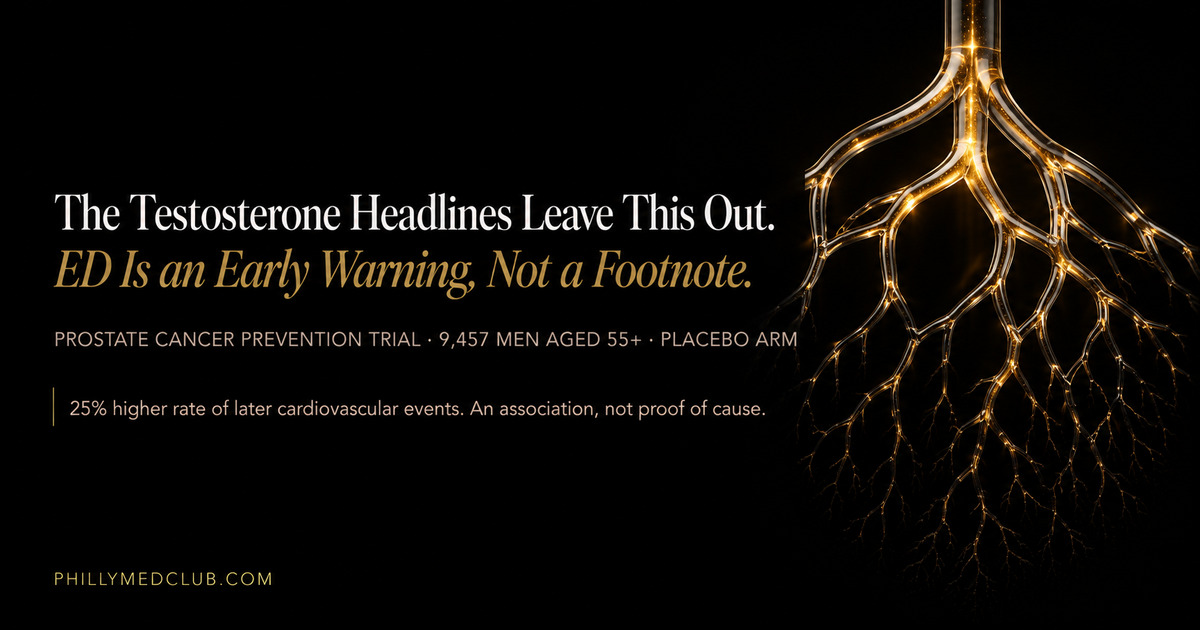
It can be, and this is the part of the conversation I care about most. In the placebo arm of the Prostate Cancer Prevention Trial, 9,457 men aged 55 and over were assessed every three months. New-onset erectile dysfunction was associated with a 25% higher rate of later cardiovascular events after adjustment for the usual risk factors; for men with either new or pre-existing ED, the figure was 45%.
That’s an association from an observational analysis, not proof that ED causes heart attacks. The mechanism is coherent, though. An erection is a vascular event, and the penile arteries are considerably narrower than the coronaries. Endothelial disease shows up in the small pipes before the big ones. The symptom can precede the cardiac event by years, which is the entire point — it’s an early warning, not a footnote.
So when a man asks me for testosterone because he’s having erection trouble, the honest answer is usually: sure, let’s check it, and let’s also check your blood pressure, your lipids, your A1c, and whether you snore. In our experience the men who arrive asking about hormones are frequently the same men who haven’t had a lipid panel in five years. Treating that is the higher-value intervention, and I say so even though it’s the one nobody pays a med spa for.
Will testosterone therapy help, and is it safe?
In men with genuinely low levels and real symptoms, you’ll find benefits to replacement — and the trials showing this are specific about who was in them. The Testosterone Trials randomized 790 men aged 65 and over, all with testosterone below 275 ng/dL plus symptoms, to gel or placebo for a year. Sexual activity, sexual desire and erectile function all improved significantly. Physical function and vitality largely didn’t.
Read the entry criteria again, because they’re important. These were men with unequivocally low levels. Testosterone was not tested as an erectile dysfunction drug in men whose levels are normal, and I don’t prescribe it that way. If your testosterone is 480 and you can’t get an erection, testosterone isn’t your answer, and anyone selling it to you as one is selling you something.
On safety the picture improved recently. TRAVERSE randomized 5,246 men aged 45 to 80 with hypogonadism and either established cardiovascular disease or high risk of it. Testosterone was noninferior to placebo for major adverse cardiac events, which settles a fifteen-year argument in testosterone’s favour. It is not a clean bill of health: the testosterone group had more atrial fibrillation, more pulmonary embolism and more acute kidney injury. Those aren’t nothing, and they’re why monitoring isn’t optional.
Two more things before you start. Exogenous testosterone shuts down your own production and suppresses sperm production — if fertility is on your list, this is the wrong drug. And diagnosis takes two separate fasting morning measurements, which is what both of those trials used. If a clinic offers to start you on testosterone off one afternoon blood draw, that clinic is not being careful with you.
Does the P-Shot work for erectile dysfunction?
The evidence does not settle it, and we offer it anyway — so let me lay out both halves of that.
The best-designed single trial is the honest place to start: a randomized, double-blind, placebo-controlled study of two PRP injections in men with mild-to-moderate erectile dysfunction found no difference between PRP and placebo in the proportion of men reaching a clinically meaningful improvement at one month — 58% versus 54%, which is a coin flip.
A pooled meta-analysis of the placebo-controlled literature was more favourable, reporting an average improvement of around three points on the erectile function domain at one, three and six months. But the pooled studies are small, the follow-up is short, and a more recent pooled analysis has since concluded that PRP does not produce a consistent, clinically meaningful improvement over placebo. Taken together, the literature has moved toward caution rather than confidence, and no professional body currently endorses the treatment.
Where does that leave the service? Available, with the trial data on the table. One of our physicians performs it, and he does the numbing himself — topical anaesthetic first, then subcutaneous lidocaine, which is the part nobody puts in the brochure. It stings, properly, and I’m not going to pretend otherwise. PRP is your own blood and the safety record in these studies is good, so the real downside is your money and an uncomfortable twenty minutes.
And then the decision is yours, which is where it belongs. We have patients who chose to try it and report a favourable outcome, and I take that seriously without mistaking it for trial evidence. If a man wants to go ahead after hearing all of the above, we will do it properly. If he’s choosing between PRP and getting his cardiovascular risk properly assessed, I’ll push hard for the second one.
What should gay and bisexual men over 50 ask for specifically?
Extragenital screening. Gonorrhea and chlamydia at the throat and rectum are frequently asymptomatic, and a urine test will not find them. Ask to be swabbed at the sites that match what you actually do, and don’t wait to be offered — plenty of primary care providers still don’t ask the question that would prompt appropriate testing.
We are not an HIV practice, we don’t prescribe PrEP, and we don’t do STI screening in this office at all. That work belongs with a dedicated sexual health clinic or a primary care physician who will actually ask the questions. What this practice can do is the hormone and metabolic half of the picture: measure things properly, treat what’s treatable, refer the rest.
Which is, in the end, close to what the original article said, minus two numbers. Get the physical. Say the awkward part out loud to someone whose job it is to hear it. The change you noticed may be the most useful signal your body has given you in years.
References
Temporal trends in total and free testosterone (1972–2019): a systematic review and meta-trend analysis. Presented at: European Society of Human Reproduction and Embryology Annual Meeting; July 2026; London, UK. (conference presentation — not peer-reviewed; full methods not yet published)
Wu FC, Tajar A, Pye SR, et al. Hypothalamic-pituitary-testicular axis disruptions in older men are differentially linked to age and modifiable risk factors: the European Male Aging Study. Journal of Clinical Endocrinology and Metabolism. 2008;93(7):2737–2745. doi:10.1210/jc.2007-1972
Cheng H, Zhang X, Li Y, et al. Age-related testosterone decline: mechanisms and intervention strategies. Reproductive Biology and Endocrinology. 2024;22:144. doi:10.1186/s12958-024-01316-5 (narrative review)
Thompson IM, Tangen CM, Goodman PJ, Probstfield JL, Moinpour CM, Coltman CA. Erectile dysfunction and subsequent cardiovascular disease. JAMA. 2005;294(23):2996–3002.
Snyder PJ, Bhasin S, Cunningham GR, et al. Effects of testosterone treatment in older men. New England Journal of Medicine. 2016;374(7):611–624. doi:10.1056/NEJMoa1506119
Lincoff AM, Bhasin S, Flevaris P, et al. Cardiovascular safety of testosterone-replacement therapy. New England Journal of Medicine. 2023;389(2):107–117. doi:10.1056/NEJMoa2215025
Masterson TA, Molina M, Ledesma B, et al. Platelet-rich plasma for the treatment of erectile dysfunction: a prospective, randomized, double-blind, placebo-controlled clinical trial. Journal of Urology. 2023;210(1):154–161. doi:10.1097/JU.0000000000003481
Panunzio A, Labate C, Zacheo F, et al. Platelet-rich plasma intracavernosal injections for the treatment of primary organic erectile dysfunction: a systematic review and meta-analysis of contemporary controlled studies. International Journal of Impotence Research. 2024;36(6):562–571. doi:10.1038/s41443-023-00798-y
.png)