
Semaglutide vs. Tirzepatide: A Philadelphia Physician’s Guide to GLP-1 Weight Loss in 2026
GLP-1 receptor agonists have changed obesity medicine, and that isn’t hyperbole — it’s what the clinical trial data shows. What has come with the demand is a great deal of marketing noise, regulatory upheaval and a fair amount of misinformation.
I prescribe these medications daily and this practice profits from doing so, which you should keep in mind while reading. What I can offer in return is the evidence as it stands, what changed in 2026, and where I’d tell you to be careful.
How do semaglutide and tirzepatide actually work?
Semaglutide — sold as Ozempic for diabetes and Wegovy for weight loss — is a GLP-1 receptor agonist. It mimics the incretin hormone GLP-1, which your body produces naturally after eating. The result is reduced appetite, slower gastric emptying and improved blood sugar regulation.
Tirzepatide — Mounjaro for diabetes, Zepbound for weight loss — is a dual GIP/GLP-1 receptor agonist, meaning it activates both receptors. That dual mechanism appears to produce greater metabolic effects, though exactly how much of that comes from the GIP side is still being worked out.
Both are once-weekly injections under the skin. Both need gradual dose escalation over several weeks to keep gastrointestinal side effects manageable.
Which one produces more weight loss?
Tirzepatide, with the only head-to-head trial that exists.
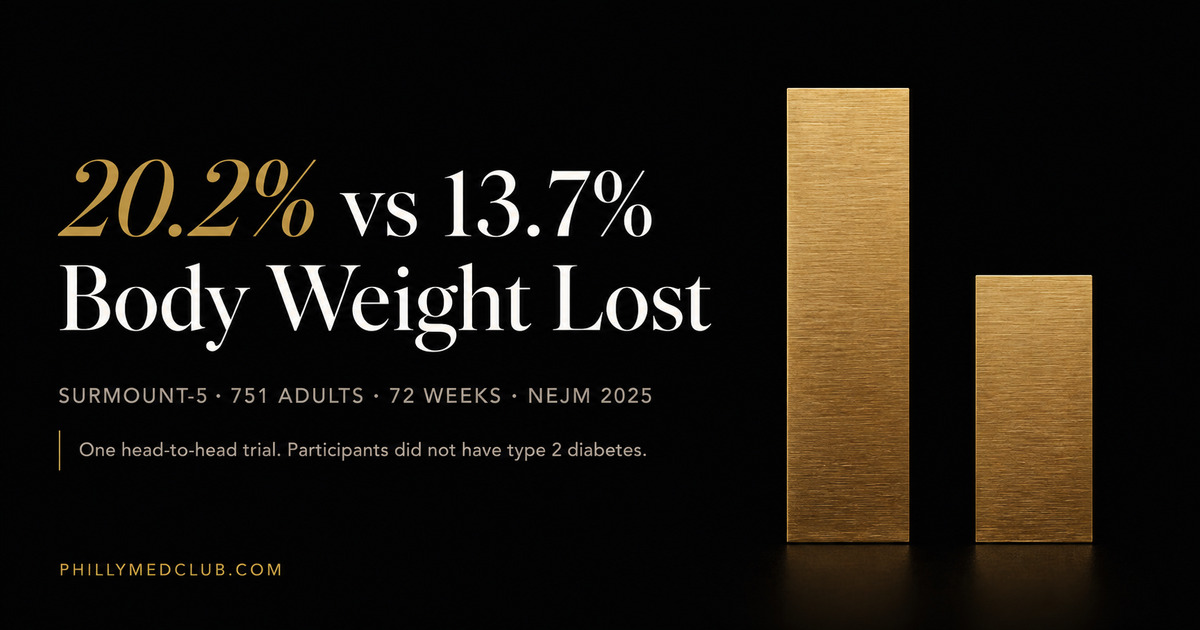
SURMOUNT-5 enrolled 751 adults who were living with obesity, or with excess weight plus at least one weight-related condition, and who did not have type 2 diabetes. Full results were published in the New England Journal of Medicine in May 2025. Over 72 weeks, patients on tirzepatide lost an average of 20.2% of their body weight against 13.7% on semaglutide. Waist circumference fell 18.4 cm versus 13.0 cm. Both differences were statistically significant.
A 2025 indirect treatment comparison pooling trial and real-world data found the same direction of effect, with a mean difference of roughly 4 to 4.5 percentage points. A network meta-analysis of 28 randomised trials covering more than 34,000 participants, published in the Journal of Diabetes in February 2026, reached the same conclusion across percentage weight reduction, absolute weight loss, BMI and waist circumference.
On tolerability, gastrointestinal effects are common with both during dose escalation. In SURMOUNT-5, the events severe enough to stop treatment were actually more frequent with semaglutide, at 5.6%, than with tirzepatide, at 2.7%.
Fact vs. Fad: “GLP-1s cause muscle loss” gets repeated without much nuance. Weight loss by any method, including diet and exercise, involves losing some lean mass. The proportion lost in GLP-1 trials is consistent with what you’d expect from a caloric deficit. The clinical answer is resistance training during treatment, which we discuss with every patient and frequently coordinate with trainers and physical therapists.
What changed with compounded GLP-1s in 2026?
The legal basis for large-scale compounding went away, and that’s the part patients most need to understand.
Between 2022 and 2024 both medications sat on the FDA’s drug shortage list, which legally permitted compounding pharmacies to produce them at far lower cost — roughly $150 to $300 a month against $1,000 or more for brand-name. At peak, compounded versions accounted for something like 30% of U.S. supply.
The FDA declared the tirzepatide shortage resolved in December 2024 and semaglutide in February 2025. On 30 April 2026 the agency proposed formally excluding semaglutide, tirzepatide and liraglutide from the 503B Bulks List, which would permanently close that pathway. By early 2025 the FDA had received more than 455 adverse event reports linked to compounded semaglutide and more than 320 linked to compounded tirzepatide, many involving dosing errors with multi-dose vials.
Fact vs. Fad: “Compounded GLP-1s are just as good as brand-name.” Compounded medications are not FDA-approved and have not gone through the same testing for potency, purity and sterility. That doesn’t mean every compounding pharmacy produces an inferior product. It does mean the quality assurance standard is objectively different, and the dosing-error reports above are what that difference looks like in practice. We prescribe FDA-approved medications obtained through licensed distributors.
What does the program actually involve?
A full medical evaluation first. GLP-1 therapy isn’t appropriate for everyone and it is never a standalone solution, so we assess cardiovascular risk, metabolic panels, medication interactions and personal history before anyone writes a prescription.
After that, monthly monitoring during dose titration and quarterly once you’re at maintenance. We talk about nutrition, resistance training, and the fact that these medications work best as one component of a broader plan rather than as the plan itself. Patients on a GLP-1 frequently ask about IV hydration and vitamin injections while their intake is down — whether either is worth doing is a question for that visit, not an automatic add-on.
Current pricing sits on our medical weight loss page. We’ll also help you navigate manufacturer savings programs and direct-from-manufacturer pharmacy options where those work out cheaper for you — even if that means we make less.
So which should you take?
Both are effective and well studied. The head-to-head data gives tirzepatide the edge on total weight reduction, while semaglutide has a longer track record and broader insurance coverage — and coverage is often what actually decides it.
Neither works without the rest: physician supervision, behavioural change, monitoring. If you’re considering GLP-1 therapy, talk to a physician rather than a telehealth ad, a social media influencer, or a pharmacy that will ship medication without a proper evaluation. A complimentary consultation will tell you whether you’re a candidate and which medication makes sense for your situation.
References
Aronne LJ, et al. Tirzepatide as compared with semaglutide for the treatment of obesity (SURMOUNT-5). New England Journal of Medicine. 2025;393:26–36. doi:10.1056/NEJMoa2416394. NCT05822830 (randomised, open-label, head-to-head trial, n=751)
Bernardi JC, et al. Who wins the battle against obesity? A network meta-analysis comparing tirzepatide and semaglutide. Journal of Diabetes. 2026;18(2). doi:10.1111/1753-0407.70192 (network meta-analysis, 28 trials, n>34,000)
Hankosky ER, et al. Diabetes, Obesity and Metabolism. 2025;27(7):3757–3765. doi:10.1111/dom.16401 (indirect treatment comparison)
U.S. Food and Drug Administration. Proposed exclusion of semaglutide, tirzepatide and liraglutide from the 503B Bulks List. Federal Register; public inspection 30 April 2026, published 1 May 2026.
.png)