
Morpheus8 vs. Microneedling: The Difference Isn’t Depth, It’s Heat
The way this gets explained online is that microneedling is the starter version and Morpheus8 is the upgrade — deeper needles, better results, more money. That framing is wrong, and it’s wrong in a way that sends people to the more expensive treatment when the cheaper one was the right tool.
We perform both. We charge more for Morpheus8. So take the following with that in mind — I’m about to argue that a meaningful number of people should book the less expensive option.
Isn’t Morpheus8 just deeper microneedling?
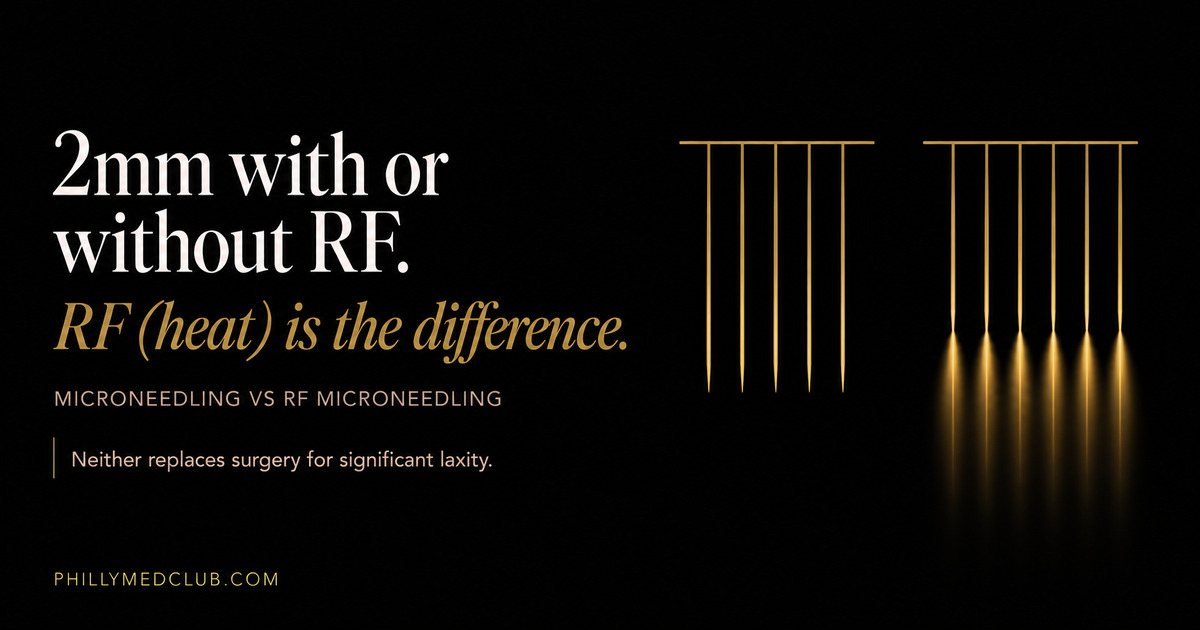
On the face, not really. At our standard settings both run at a similar depth — often around 2mm — though the number isn’t fixed, and I’ll come back to why.
The figure you’ve probably seen quoted, 7 or 8mm, is a body treatment. That’s a different handpiece for abdomens, flanks and thighs. Nobody is putting a needle 7mm into a cheek. When a website advertises Morpheus8’s maximum depth on a page about facial rejuvenation, it’s borrowing a number from a procedure it isn’t describing.
So if you and I sat down and I treated one side of your face with microneedling and the other with Morpheus8, at our standard settings, the needles would be going to about the same place. One side would get heat. The other wouldn’t.
That’s the whole difference. And it turns out to be a large one.
What does the heat actually do?
There’s a study that answers this almost perfectly, because its design is exactly the comparison I just described.
Hwang and colleagues at Seoul National University Hospital ran a split-face, double-blind, randomised trial in thirty women aged 60 and over. One side of each face got RF microneedling. The other got microneedling alone. Four sessions, four weeks apart. Critically, both sides were treated at the same 1mm needle depth — the RF side simply had the energy turned on, and the microneedling side had it set to zero.
Depth held constant. Heat as the only variable. That is the experiment.
The RF side came out ahead on essentially everything measured. More procollagen. More collagen and more elastin in the papillary dermis. Better wrinkle scores, and they appeared sooner — at three months the microneedling side hadn’t yet reached statistical significance while the RF side had.
The mechanism they propose is the interesting part. Aged skin accumulates senescent fibroblasts — cells that have stopped dividing but keep sitting there emitting inflammatory signals. On the RF side, the number of these senescent cells dropped and the number of healthy, actively dividing fibroblasts rose. The thermal energy appears to clear out the exhausted cells and let new ones repopulate. Plain microneedling didn’t do that.
Two things I want to say about this study:
The corresponding author disclosed research funding and device support from the company that makes the RF device used. That doesn’t invalidate the work — it’s a well-designed trial in a good journal with a genuine control — but you should know it, and you should apply the same scepticism to any study a clinic quotes at you, including this one.
And the effect was confined to the papillary dermis. The deeper reticular dermis showed no significant difference between sides. So “RF remodels the deep tissue” is doing more work in marketing than in this data.
Then why would anyone choose plain microneedling?
Because for deep acne scarring, I think it’s often the better tool, and I’d tell you that even though it costs you less.
Scar tissue is a mechanical problem before it’s a collagen problem. Atrophic scars are tethered down by fibrous bands, and what helps is physically disrupting those bands and letting the skin release upward. Needles do that. Heat is not what breaks a tether.
The evidence for microneedling alone here is solid. A systematic review of randomised controlled trials found it consistently effective for atrophic acne scars, as monotherapy and in combination, with no serious adverse effects reported across the included trials. El-Domyati’s team also showed measurable histological rejuvenation from microneedling alone — this isn’t a placebo procedure.
Fact vs. Fad: “RF microneedling is better” is a claim that needs a “for what.” For skin quality and tightening in ageing skin, the head-to-head data supports it. For deep scarring, there is no equivalent trial putting plain microneedling against RF microneedling with depth held constant — nobody has run it. Anyone who tells you RF is definitively superior for scars is extrapolating from a study about wrinkles.
There’s a practical point too. Adding heat to inflamed, actively breaking-out skin is not always what that skin needs.
Who decides the depth and the energy?
The honest answer is that there is no correct depth. There’s a correct depth for your skin, on the day, in that area of your face — and the same is true of the energy, which is to say the heat.
Skin thickness varies enormously between people and between regions of one face. The settings that suit a thick-skinned 40-year-old cheek are wrong for thin periorbital skin on someone twenty years older. Both numbers get set by the person holding the handpiece, patient by patient.
Sometimes that means going deeper. Jowls and submental fullness — the area under the chin — are where we’ll place the needle tips into the fat itself and run higher energy, because the target there isn’t the dermis. That’s a deliberate decision on a particular anatomy, not a default.
Which brings me to something most practices won’t put in writing.
In my experience, the Morpheus8 horror stories are mostly true. The tracking marks, the prolonged swelling, the reports of fat loss where someone wanted tightening — I think those are real, and I think they are almost always the same failure: wrong depth, energy set too high, or both. It is not a mysterious device risk. It’s an operator putting thermal energy into a plane where it didn’t belong, or too much of it into the right one.
That’s an uncomfortable thing to say when you sell the treatment. I’d rather say it, because it’s the entire reason this procedure is performed here by a physician or our advanced practice nurse — and why the provider you select when you book is the provider who performs it. We have performed more than seven hundred of these treatments in this office, running at roughly three hundred a year. That number isn’t a boast — it’s the only honest answer to “how do I know my settings will be right,” which is the question you should actually be asking.
What won’t either of them do?
Replace surgery.
A 2026 scoping review in JMIR Dermatology cited work finding that a single session of fractional bipolar RF microneedling achieved roughly 37% of the skin laxity improvement produced by a surgical facelift. A third is a real result. It is also a third.
If your jawline has genuinely descended, a series of Morpheus8 will improve skin quality and give you some tightening, but it will not do what a facelift does. I would rather tell you that at the consultation than have you conclude it after spending several thousand dollars.
Neither treatment fills volume, either. If the complaint is hollowness rather than laxity, you’re in the wrong section of the menu.
So which should you book?
If the concern is deep acne scarring: microneedling, in a series. Possibly with subcision for tethered scars.
If the concern is crepey texture, fine lines, early laxity, pore size, skin quality: Morpheus8. The heat is doing something the needles alone don’t.
If it’s both — and it often is — we run them in sequence rather than picking one. For someone with deep acne scarring or settled lines, we start with plain microneedling to do the corrective work, releasing the tethered tissue and rebuilding what’s atrophic. Once that’s addressed, we follow with Morpheus8 to tighten and drive further collagen. Correct the structure first, then tighten what’s over it. Doing it the other way round means tightening skin across a defect you haven’t fixed yet.
One more thing about how we run these. We include PRP with every microneedling treatment, drawn from your own blood, used as the gliding agent during the procedure and as the post-procedure mask, at no extra charge. There’s nothing in it to react to.
Come in and let us look at your skin. Sometimes the honest answer is the cheaper treatment, and you should be suspicious of a practice that never says so.
References
Hwang JM, Lee SH, Baek EJ, Kim HRC, Oh JH, Lee JS, Lee SH. Comparison of the effects of fractional microneedle radiofrequency and microneedling on modulating the senescent fibroblast milieu in aged skin. Scientific Reports. 2025;15:18296. doi:10.1038/s41598-025-02545-3
Sitohang IBS, Sirait SAP, Suryanegara J. Microneedling in the treatment of atrophic scars: a systematic review of randomised controlled trials. International Wound Journal. 2021. doi:10.1111/iwj.13559
El-Domyati M, Barakat M, Awad S, Medhat W, El-Fakahany H, Farag H. Multiple microneedling sessions for minimally invasive facial rejuvenation: an objective assessment. International Journal of Dermatology. 2015;54(12):1361–1369.
Xu, et al. Microneedle radiofrequency induces extracellular matrix remodeling through fibroblast activation: a histological study in a porcine model. Lasers in Surgery and Medicine. 2025. doi:10.1002/lsm.70033
Alexiades-Armenakas M, Rosenberg D, Renton B, Dover J, Arndt K. Randomized, quantitative grading comparison of minimally invasive, fractional radiofrequency and surgical face-lift to treat skin laxity. Archives of Dermatology. 2010;146(4):396–405.
Panlilio M, Bolen R, Martini O, Bonk A, Tedesco J. Navigating the intersection of radiofrequency microneedling and surgical facelifts: scoping review. JMIR Dermatology. 2026;9:e78385.
.png)